Earth, Water, Air, Fire!
The four elements in Greek cosmology that define matter, and the substance of nature and the environment are: Earth, Water, Air and Fire. This is fanciful by today’s standards, however, the ancients weren’t so wrong. We just have a lot more granularity now, as evidenced by our ability to see what is happening at the molecular level.
This is tremendously important when it comes to environmental matters. Climate change dominates the conversation, and for good reason. There is a lot of focus on the atmosphere, and greenhouse gases (GHGs).
But the entire environment is under siege from the activities of human activity and it’s non-sensical to describe concerns about water as secondary to those about the atmosphere. Water covers around 71 percent of the surface of the Earth, with about 96.5 percent of all water held in the oceans.
Life on Earth…
As part of the ecosystem that sustains life on Earth, the contribution of the oceans is almost incalculable. Their vast size means we can lose an entire 200 tonne, 70 metre wingspan airliner beneath the waves, almost without a trace, despite using our most sophisticated technologies to locate it. However, the behaviour of some 8 billion humans is managing to swamp the seas with vast amounts of pollution, threatening marine species and the long-term prospects for our own.
On the planet that mankind calls ‘home’, rendered blue due to the abundance of water when observed from space, about 1 in 10 people (about 800 million) do not have access to safe water. Of these around 490 million take water from unprotected wells and springs or collect untreated surface water from lakes, ponds, rivers and streams. This of course brings a serious risk of exposure to disease vectors or toxins.
In developed economies domestic drinking water supplies contain many unwelcome substances. Many use chlorine in the water treatment process to kill harmful bacteria and to keep water germ-free when on its journey to the tap.
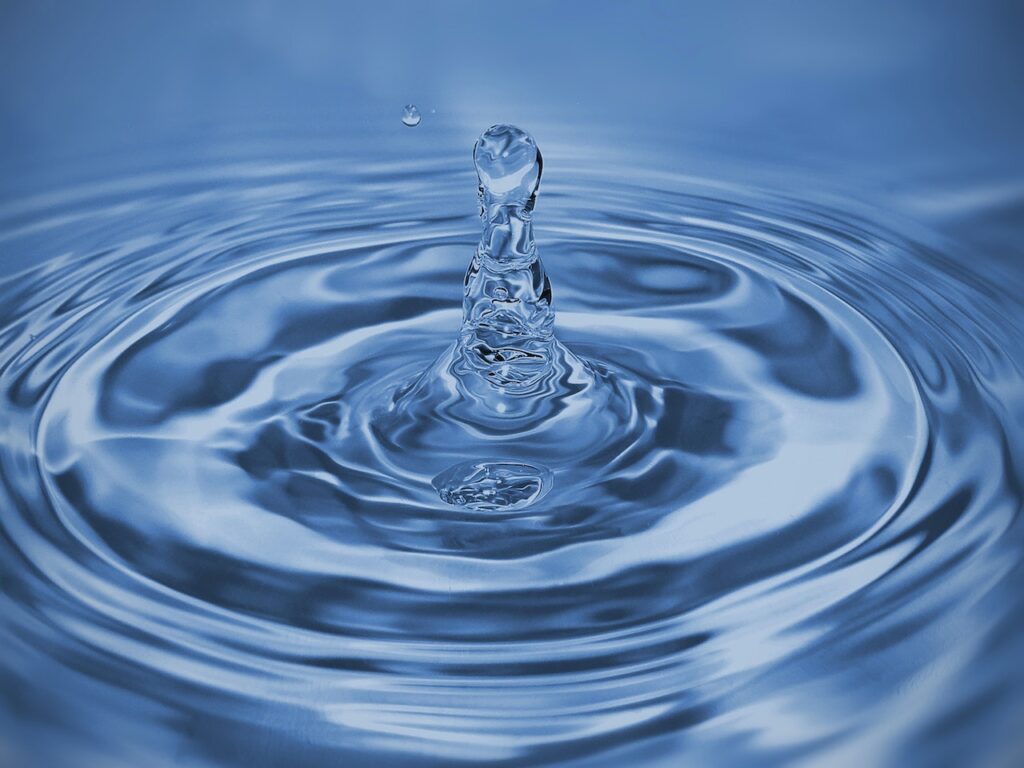
| PHOTO CREDIT | PEXELS | Aleksandr Slobodianyk | Free to use | Close-up Photo of Water Drop |
What is found in drinking water?
H2O
Of course, the main component of drinking water is H2O. The chemical formula, indicates that each of its molecules contains one oxygen and two hydrogen atoms, connected by covalent bonds. The hydrogen atoms are attached to the oxygen atom at an angle of 104.45°. ‘Water’ is also the name of the liquid state of H2O at standard temperature and pressure.
Chlorine
Chlorine is widely used by municipal authorities around the world to disinfect drinking water supplies. It is highly effective against bacteria and parasites. There are issues with preventing overdosing, and the risks associated with by-products that result when it reacts with organic compounds that may be present in water. It also causes an unpleasant taste that is instantly noticeable when compared with water sourced from springs.
Limescale
Limescale is a hard, chalky deposit, consisting mainly of calcium carbonate (CaCO3). It often builds up inside kettles, boilers, and pipework, especially that for hot water. It is also often found as a similar deposit on the inner surfaces of old pipes and other surfaces where ‘hard water’ has flowed.
Fluoride
Some municipal authorities add fluoride to drinking water for the purposes of promoting better dental health. However, excess amounts of fluoride ions in drinking water can cause dental fluorosis, skeletal fluorosis, arthritis, bone damage, osteoporosis, muscular damage, fatigue, joint-related problems, and chronic issues.
Lead
Efforts have been made to eliminate lead pipework from municipal water infrastructure. However, there may be legacy elements of infrastructure and pipework within homes and buildings. The most common sources of lead in drinking water are lead pipes, taps, and plumbing fixtures. Other heavy metal ions are also of concern.
Microplastics
Another environmental issue of great concern is the widespread contamination by plastic waste. Microplastic particles have been found in just about every place on Earth, such as the remotest areas of the land, including Antarctica, the oceans, and the digestive systems of living things.
The effects of man-made hydrocarbon-derived polymers and their long term implications for life on Earth are yet to be fully understood.
Bacteria, viruses & parasites (pathogens)
Some of the bacteria and viruses that have been found in tap water include legionella, coliforms, E.coli and enteroviruses. Common parasites and worms include midge larvae, flatworms, roundworms (nematodes), and rotifers. Some typical sizes are 30-50 microns in diameter, about 1/20th of a millimetre or less.
Synthetic hormones
Steroid hormones such as oestrogens and testosterone enter the municipal treatment infrastructure via wastewater. Water companies treat it but tap water may still contain traces of hormones. You can find out more in this post dedicated to the topic of oestrogens in tap water.
Pharmacological compounds
Pharmaceutical pollution results from biologically active substances contaminating the environment. While many of these compounds are used in the treatment of human and animal health, others may be classed as illegal substances. They are often not fully metabolised by the body, so the complex compound and/or its by-products are excreted and enter municipal water infrastructure and river systems.
You get the picture!
This list is by no means exhaustive, but it provides an idea of the variety of contaminants that may be passing between your lips when you drink that glass of tap water… Explore our other blogs to see how ozone is able to help provide cleaner water.
